
Lifestyle
Fueled By ‘Mental Toughness, Former NFL Player Roy Hall Jr.Turns to Motivational Speaking

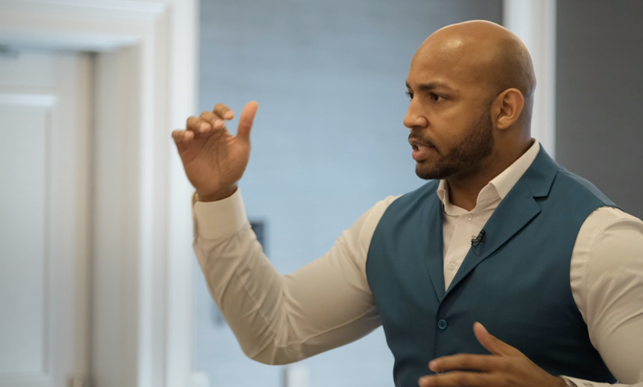
Roy Hall, Jr., a former NFL player with the Lions, Saints, and Colts painfully accepted that after four years in the NFL, he had to move on. In 2007, Hall’s rookie season came to a rough ending after a violent head-to-head collision during a routine kickoff, with Cedric Killings of the Houston Texans. “I ended up with a third-degree shoulder separation, and Cedric unfortunately suffered a fractured vertebra in his neck,” Hall shared in a previous interview with Disrupt Magazine.
While Killings went on to retire, Hall had a different, challenging pathway ahead of him on his journey towards recovery, which began in 2008. “I had a knee scope and had complications that kept me out for 12 games, followed by a microfracture surgery the following year, which forced me to miss the entire season,” he told Big Time Daily.
In 2010, Hall was released by the Saints after tearing muscles in his hip, ultimately ending his professional career in the NFL. “For three seasons, I watched how people reacted when I told them I was hurt, or exposed teams to my injury history. I watched how players reacted to their own rehab,” noticing how some worked extremely hard, while others were trapped in depression.
“Life is 10-percent what happens to you, and 90-percent of how you respond to it,” Hall told Big Time Daily. “There are things in life that happen in which you have no control over, but what you can control is your response when things don’t go your way. When adversity strikes, if you respond the right way, adversity can give you an advantage. Some people call it a chip on your shoulder. I just think it gives you stronger shoulders to hold up more weight that’s trying to push you down.”
Hall, an Ohio-native and the co-founder and Executive Director of the Driven Foundation, now spends his time taking those tough lessons and translating them for a corporate audience to help companies of all sizes across the country motivate and train their people.
“Today’s climate has really inspired me to do my best to be a light,” he emphasized. “Tough conversations have to be had. Tough meetings need to be had. Companies across the country bring me in to speak to their employees and executive teams about diversity and inclusion, and provide perspective. They hire me to motivate and inspire – translating the toughest lessons from my football career to drive employees in a corporate environment. I’m more inspired than ever to speak and train professionals to just be better people.”
Hall revealed that during his time in the NFL, the organization taught him “how to leverage [his] platform for something greater than [himself],” turning to motivational speaking and community empowerment. The former NFL player regularly speaks in cities like Las Vegas with a room full of professionals.
“I’m the middle man. I’m the connector. I introduce privilege to poverty. I get people to serve that have more to give than most. What you have can either be taken away, or given away. It’s much better to give than to have something taken from you. Purpose is service.”
And that service continues to flow into his community. Hall started the Driven Foundation back in 2008 with his former Ohio State teammate, Antonio Smith, to provide families with basic needs to combat poverty and promote independence.
Over the last 12 years, Hall and Smith have distributed over 1.25 million pounds of free food to over 9,000 Ohio families. They have also created their own leadership and character building curriculum, called Youth Leadership, which is another component to the Driven Foundation. The curriculum is tailored to students in 5th-12th grade, where both Hall and Smith work with over 30 middle-schools and high-schools throughout Ohio.
“Each year we also distribute over 500 backpacks filled with school supplies, while donating 100 winter coats to students in need. Whatever we didn’t have as kids, we do our best to lighten that load for families in Ohio.”
Hall’s favorite topics as part of the Youth Leadership curriculum are those that involve “improving your attitude so that you feel like a winner every day” and “how to respond maturely when things don’t go your way.”
“…these are lessons that they can not only use to help them academically but will help them for the rest of their lives. Having former NFL players and local executives take on the roles as ‘coaches’ for these students is huge. Not only are they getting the information, but they are hearing from people that have done or are doing what their dreams are.”
To Hall’s point, individuals must be trained on how to respond to different situations, specifically when it comes to responding to challenges that aren’t always expected.
“For perspective there are 1.5 million nonprofit organizations in the United States and 40,521 nonprofits in just Ohio! The organizations doing the good in communities and for humanity are all competing against one another. However, Hall’s belief is that “…giving to others is how you get ahead. It’s also how you give people opportunities for them to get back on their feet.”

Most teams don’t fall apart all at once. It happens slowly, missed conversations, quiet disengagement, people doing what’s required but nothing more.
Toba Ogunremi has spent years working inside care environments where that kind of shift is easy to miss until it starts affecting everything. Leading operations at Samorem Care in the UK, he has seen how systems can appear stable on the surface while teams underneath struggle to stay connected to their work.
One experience early in his career changed how he looks at leadership entirely.
He had taken over a team that wasn’t in crisis, but it wasn’t working well either. The people receiving care were safe, but they weren’t thriving. The same was true for the staff. There was no urgency, no energy, just routine.
The usual solution would have been to tighten control by setting new targets, increasing supervision, and creating performance plans. He didn’t do any of that.
“I started with conversations,” he says. “Real ones. Not rushed, not formal.”
One by one, he spoke to each team member. What came out wasn’t frustration with the job itself, but something quieter and harder to spot.
“They weren’t disengaged because they didn’t care,” he explains. “They were disengaged because they felt unseen.”
No one had asked what they thought. No one had taken the time to understand how they were coping. Over time, that absence had turned into distance. That moment stayed with him. It shaped how he leads today.
His approach is simple, but not always easy to apply: people perform better when they feel they belong.
He believes high performance usually comes when people feel like they genuinely belong and know that what they do actually matters.
In healthcare, where pressure is constant and expectations are high, this idea can sound secondary. The focus is often on outcomes, compliance, and efficiency. Toba doesn’t dismiss those things, but he questions what happens when they become the only focus.
Even when all the processes are in place, if the people delivering the care feel disconnected, it eventually reflects in the quality of the work.
At Samorem Care, this thinking shows up in small but consistent ways. Recruitment is not just about experience. It’s about how someone responds to people, how they handle pressure, and how they communicate. Once they are in, the focus shifts to keeping teams stable and supported, rather than constantly rotating staff or reacting only when something goes wrong. He also pays attention to how leaders show up day to day.
According to him, leadership is not just about giving direction; it’s about being present enough to understand what your team actually needs.
That presence matters more in care than in most industries. The work is demanding, often emotional, and not always recognised for what it takes. When teams feel stretched or overlooked, it affects how they interact with the people they support.
For Toba, resilience is less about constant pressure and more about creating a work environment where people can do their jobs well without burning out. In his view, strong teams are not just coping; they are supported enough to stay clear-headed and consistent in their work.
His background outside healthcare still shapes how he leads. Having worked in sales and communications, he understands how important it is to read people and build trust. In healthcare, though, the impact is far more direct, as decisions affect someone’s everyday life, not just an outcome on paper.
That shift makes leadership more personal. Teams need more than instructions; they need stability, clarity, and a sense that they are understood. What defines Toba Ogunremi’s approach is its simplicity. He focuses on being consistent, listening carefully, and addressing issues early rather than reacting late.
In the end, his belief is straightforward: teams perform better not because they are pushed harder, but because they feel valued and part of something that works.
-

 Tech5 years ago
Effuel Reviews (2021) – Effuel ECO OBD2 Saves Fuel, and Reduce Gas Cost? Effuel Customer Reviews
-
 Tech7 years ago
Bosch Power Tools India Launches ‘Cordless Matlab Bosch’ Campaign to Demonstrate the Power of Cordless
-

 Lifestyle7 years ago
Catholic Cases App brings Church’s Moral Teachings to Androids and iPhones
-

 Lifestyle5 years ago
East Side Hype x Billionaire Boys Club. Hottest New Streetwear Releases in Utah.
-

 Tech8 years ago
Cloud Buyers & Investors to Profit in the Future
-

 Lifestyle6 years ago
The Midas of Cosmetic Dermatology: Dr. Simon Ourian
-

 Health7 years ago
CBDistillery Review: Is it a scam?
-

 Entertainment7 years ago
Avengers Endgame now Available on 123Movies for Download & Streaming for Free