
Lifestyle
Instagram Star Simonetta Lein Uses Her Influence to Inspire


The Simonetta Lein Literacy Award For Children in Nigeria
There is a growing trend: social media influencers and public figure who use their platform to empower and better society backing important causes. Simonetta Lein, considered as one of the top social media Influencers in the world, often is a true leader for this trend. Founder of The Wishwall Foundation, Lein aims to make meaningful wishes come true . When “I read To Live Initiative” wrote her about supporting education in Nigeria, Simonetta knew she needed to step up to improve the level of literacy in Nigeria; ensuring the achievement of the United Nations sustainable development targets of Quality Education.
There is an increase in the level of illiteracy in Nigeria; this has also contributed to the numbers of children out of school in Nigeria. Over the years, these challenges continue to linger considering the societal challenge of insecurity and increased rate of unemployment in Nigeria, the responsibility to protect lives and property of theNigerian people are the responsibility of government, notwithstanding, efforts of private persons, civil societies and international interventions are also critical in addressing these societal challenge.
Simonetta Lein, through The WishWall Foundation, is creating a new hope for children in Nigeria by supporting schools in rural communities, encouraging literacy and numeracy. Being a world- renowned activist, Lein is concretely using her social media network to inspire and change the world by granting meaningful wishes that will have direct and positive impacts on the lives of people globally.
In March 2019, having being contacted by Sule Jacob- Executive Director of iRead To Live Initiative in Nigeria, a non-profit organization made up of young people passionate about education Nigeria, Lein and The Wishwall Foundation supported 100 girls in a rural community with schools bags, sandals, sanitary pads and exercise books. This kind support of Lein served as a morale booster for the girls and has thus kept them in school.
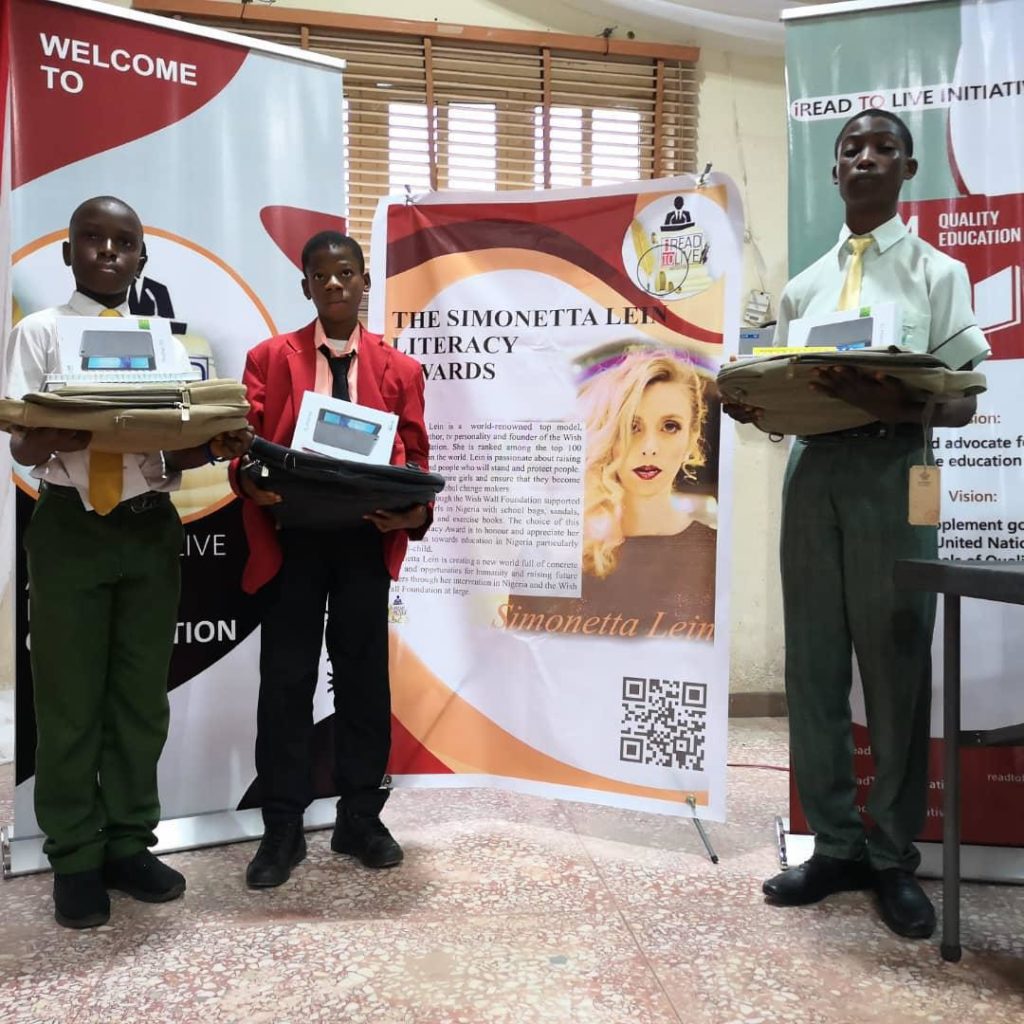
On Thursday, 6th of June 2019, Simonetta Lein in her continuous passion for inspiring and creating a new world full of hope for people, received an Honorary Literacy Award in her name ( The Simonetta Lein Literacy Awards 2019- For Children in Nigeria) in recognition of her support towards Quality and Equitable education. The award created an opportunity for students to receive prizes such as ipads, textbooks, school bags and exercise books to students with outstanding performances during the competition. During the course of the event, contestants were drawn from 45 schools which included private and public schools in Osun State, South West, Nigeria. Over 200 children participated with their teachers.
Simonetta’s efforts are quite laudable and commendable, what she is doing is appreciated and instrumental to the future of these young children in Nigeria. Moreover, she is sending a precise message to the world showing that the efforts of one’s platform can impact an entire community.
To protect elderly parents from online scams, families should combine regular communication, scam-awareness education, verification habits, and real-time scam detection tools. Scamless helps by detecting suspicious messages, phishing links and impersonation attempts across WhatsApp, SMS, Instagram, Facebook Messenger, X and TikTok before users click, reply or send money.
Why Seniors Are Targeted by Online Scams
Online scams have become a growing concern for families, particularly when it comes to protecting elderly parents who increasingly rely on digital communication for banking, healthcare, and staying connected. As scam tactics become more sophisticated, many families are searching for ways to protect elderly parents from scams, explore scam protection for seniors, and find reliable tools, such as a senior fraud prevention app or family scam protection app that can provide real-time safety across messaging platforms.
Scamless is an AI-powered scam detection app that helps users detect suspicious messages, phishing links and impersonation attempts across apps such as WhatsApp, SMS, Instagram, Facebook Messenger, X and TikTok before they click, reply or send money.
Arjun Singri, founder of Scamless, explains that the vulnerability of seniors is not linked to awareness or intelligence, but to the evolving nature of digital manipulation. “The challenge is that scams are designed to blend into everyday communication,” he says. “They appear as normal messages, often from sources that feel familiar and trustworthy.”
Common Scams Targeting Elderly Parents
Scammers frequently target older adults through emotional and time-sensitive messaging. These include fake bank alerts, impersonation of family members, delivery notifications, and urgent account security warnings. Each message is structured to create urgency and reduce the likelihood of verification. Singri notes that this emotional pressure is central to how fraud succeeds. “When urgency enters the conversation, people tend to act before they validate,” he says.
One of the most common risks involves impersonation scams, where attackers pretend to be a relative or a trusted institution. These messages often request immediate financial assistance or sensitive information. In many cases, they are delivered through messaging platforms where conversations feel private and personal, making detection more difficult.
Another frequent category includes fake bank texts and account alerts. These messages claim that accounts have been compromised or transactions require immediate verification. They often contain links that lead to fraudulent login pages designed to capture credentials. Delivery scams and fake shopping notifications also remain widespread, especially during periods of high online purchasing activity.
Singri explains that these patterns are intentional and highly structured. “Scams are not random messages,” he says. “They are carefully designed interactions that guide someone toward a decision without giving them time to question it.”
For families, this creates a unique responsibility. Protecting elderly parents from scams is no longer limited to education alone. It requires ongoing support and systems that can assist in real-time as threats appear. Caregivers often play a critical role in helping seniors identify suspicious messages, verify requests, and avoid rushed decisions.
However, human oversight alone has limitations. Messages can arrive at any time, and scams often unfold within seconds of engagement. This is where technology becomes an important layer of protection.
How Scamless Supports Family Scam Protection
Scamless operates as a scam protection app for seniors and a family scam protection app designed to help detect suspicious messages, phishing links, and impersonation attempts across platforms such as WhatsApp, SMS, Instagram, Facebook Messenger, X, and TikTok. It functions as a senior fraud prevention app by analyzing communication in real time and flagging potential risks before action is taken.
The system identifies patterns associated with manipulation, including urgency cues, unusual requests, and inconsistencies in sender behavior. When a risk is detected, it provides real-time scam alerts that explain why a message may be unsafe. This allows both seniors and family members to understand the context of the threat rather than relying on uncertainty.
Why Real-Time Scam Alerts Matter for Seniors
Singri emphasizes that clarity is a critical part of protection. “People do not need more fear,” he says. “They need understanding at the moment a decision is being made.”
One of the key advantages of using a family scam protection app is shared awareness. Families can support each other in identifying suspicious communication patterns and reinforcing safe digital habits. This creates a collaborative approach where protection is distributed across both technology and human support.
Caregivers often look for tools that reduce friction for seniors while still offering strong protection. Scamless is designed to integrate into everyday communication without requiring additional steps from the user. It helps users check suspicious messages before clicking, replying, or sharing sensitive information, reducing the risk of accidental engagement with fraudulent content.
Singri explains that timing is often the deciding factor in whether a scam succeeds. “Most scams succeed in moments where someone feels pressured to respond quickly,” he says. “If that moment is interrupted with clarity, the outcome changes.”
Scam protection for seniors must also account for emotional factors. Older adults may be more trusting of messages that appear to come from family members or institutions they have interacted with for years. Scammers exploit this trust by replicating tone, branding, and communication style. This makes detection especially difficult without additional support systems.
How AI Helps Detect Senior Fraud Attempts
AI plays an increasingly important role in addressing this challenge. Scamless uses machine learning to analyze large volumes of communication data and identify patterns that may indicate fraud. It adapts continuously to new scam techniques, ensuring that protection evolves alongside emerging threats.
The platform also helps reduce dependency on manual verification. Instead of expecting seniors or caregivers to assess every message, it provides immediate analysis that highlights potential risks in context. This is particularly important in situations involving fake bank texts or urgent family requests, where hesitation is often overridden by emotional response.
Singri frames this as a shift in how digital safety is understood. “Protection should not depend on constant vigilance,” he says. “It should be built into the environment where communication happens.”
Families using scam protection tools benefit from reduced stress and increased confidence in digital interactions. Seniors gain reassurance, while caregivers gain visibility into potential risks without needing to monitor every conversation directly.
Scamless and the Future of Senior Scam Protection
The rise in scams targeting older adults reflects broader changes in communication behavior. As more daily activities move online, including banking, shopping, and healthcare coordination, the number of potential entry points for fraud increases. Scammers take advantage of this expansion by designing messages that mirror legitimate interactions.
Singri notes that this evolution requires a new approach to safety. “The environment has changed faster than people expect,” he says. “That gap is where scams find opportunity.”
Scamless addresses this gap by embedding detection directly into communication channels, allowing risks to be identified as they appear. This approach helps ensure that seniors are not left to interpret complex signals on their own, especially in high-pressure situations.
For families seeking to protect elderly parents from scams, the combination of awareness, communication, and intelligent support systems offers the most effective path forward. Education remains important, but it becomes significantly stronger when paired with real-time protection.
As digital communication continues to expand, the need for accessible and adaptive safety tools will only grow. Scam protection for seniors is no longer a secondary concern. It is a central part of maintaining trust and independence in a connected world.
For Singri, the mission is grounded in simplicity and timing. “The right support at the right moment can prevent everything that follows,” he says. “And sometimes, that moment is all that stands between safety and loss.”
-

 Tech5 years ago
Effuel Reviews (2021) – Effuel ECO OBD2 Saves Fuel, and Reduce Gas Cost? Effuel Customer Reviews
-
 Tech7 years ago
Bosch Power Tools India Launches ‘Cordless Matlab Bosch’ Campaign to Demonstrate the Power of Cordless
-

 Lifestyle7 years ago
Catholic Cases App brings Church’s Moral Teachings to Androids and iPhones
-

 Lifestyle5 years ago
East Side Hype x Billionaire Boys Club. Hottest New Streetwear Releases in Utah.
-

 Tech8 years ago
Cloud Buyers & Investors to Profit in the Future
-

 Lifestyle6 years ago
The Midas of Cosmetic Dermatology: Dr. Simon Ourian
-

 Health7 years ago
CBDistillery Review: Is it a scam?
-

 Entertainment7 years ago
Avengers Endgame now Available on 123Movies for Download & Streaming for Free