
Business
Restaurants Need a Food Delivery App of Their Own


With the dawn of mobile apps, human lives have been made considerably more relaxed and smarter. One of the perks that came along with having smart apps is having a delivery system right on your fingertips. And it gets even better when the delivery concerns food and that too from your favorite restaurants. Yes, food delivery apps are high in demands, which keeps increasing with time – according to the sources, ‘delivery’ is projected to account for $75.9 billion in gross merchandise volume by the year 2022.
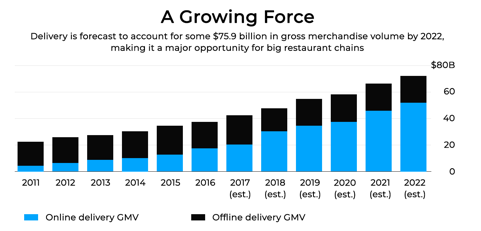
Via Tableskift.com
This gives an insight into how lucrative food delivery business has become that every restaurant owner can take advantage of by creating their own branded delivery app. Yes, there are already food delivery apps available like Uber Eats and DoorDash to make use of.
However, their commission can be quite high. This isn’t an acceptable deal for restaurants, as not only they have to pay commission as high as 25-30%, but because of a large number of orders, these third party apps cause delays, as well. The delay and high commission fee only lead to customer dissatisfaction, and it is the restaurant’s reputation that is tarnished, not the delivery app’s.
Best Route Is to Develop Your Restaurant’s Exclusive Food Delivery App.
Building your restaurant’s food delivery app and setting a personally owned food delivery system is the optimal way to curb the problems of partnering up with expensive third-party delivery apps. Now, you have the entire system in your own hands, from having your restaurant’s online app presence to exclusive deals, promos, and fast delivery options – you are the boss of it all.
So how can you go about this new exciting endeavor? Well, we would suggest approaching a reputable software development company in Houston to have your vision be translated into a kick-ass delivery app exclusive to your restaurant. But before you do that, it is essential that you are aware of the crucial features that your app would require to possess. We have created a walkthrough for you to understand it best. Continue reading:
Important Food Delivery App Features:
Since there are two main aspects you are dealing with – one is the customer section, and the other is the riders section; You need an app that is functional enough to be accessed by both parties for smoother operations. Your app should let customers quickly order through your app, and the orders can then be allocated to the riders that can access the necessary information of the customer – which is the address alongside the exact order placed.
So let’s talk about the basic features associated with the customer section of your app. Since they are the main focus and just having a customer dedicated delivery app, only does the work as well.
Delivery App Features for Customers
Note that these features should be simple, to the point, and satisfying all user needs.
- Sign-up Page: An inviting sign-up page will give a promising feel to the potential customers and win their loyalty. Keep the sign-up form and page simple, to the point, and attractive. It should let the user successfully create a new account with two basic username and password fields. Another popular sign-up feature you can offer is signing up through a third-party service like Facebook or Google.
- Account Page: This page should be able to have a form to fill in their personal details that you may require and set up their entire profile. Their profile should let them choose multiple payment options, including cash on delivery, a page to access saved order history, ability to re-order, and of course, access to your menu so they can order in the first place.
- Order Process: The idea of having a mobile app for your restaurant is to be able to order easily. So make sure you are providing them with enough edit options to add or delete items as they try to make up their mind. Now, once the order has been placed, it is best to display the estimated time of delivery. Since we are speaking your own team of riders, it is best to notify once the rider is on the way, and a tracker to locate him via Google Maps is cherry on top.
- Payment Processing: If you are allowing online payment options, then make sure your app is secure and reliable with multiple other options available. Remember, customers, come first.
- Loyalty Program: You must take care of your loyal customers and attract others to become loyal with a rewarding loyalty program. You can set up a point system and offer them great deals like free delivery or a food combo at a low price after they collect a certain amount of points. Just devise a win-win strategy for the loyalty program that will entice the users to keep using your app.
Keep in Mind:
- That the delivery app should represent your restaurant well in all aspects.
- The app should aim towards an impeccable user-experience, so do not have unnecessary requirements to be incorporated into your app.
- Have clean and simple design aesthetics in mind, the professional web-designers will help you with it.
- Lastly, don’t forget to market the app to increase brand visibility and attract users to use your exclusive delivery app and enjoy your restaurant’s food.
Go for It!
If you are still not sure whether to invest in an on-demand online food delivery app, then this statistics report by Statista might change your mind. According to it, in 2023, the revenue of online food delivery is projected to grow up to $22,898.2 million. These are great digits, and your restaurant too can reap the benefits and increase your revenue by a good margin, provided that you already have a great customer-base indulging in your delicious food. Because then the customers will be more than excited to have your dishes delivered to their homes as they relish in the taste watching their favorite shows or a great get together with family and friends.
Business
Ipsos Helps Brands Understand How They Get Customer Experience Wrong & Why It’s Costing Them Millions
For brands looking to succeed in the modern business ecosystem, the customer experience (CX) is not something companies can afford to ignore. CX is a direct driver of revenue, loyalty, and growth for organizations.
Ipsos, one of the world’s leading market research firms, helps brands understand that failing to focus on the customer experience can lead to lost sales, which in turn can translate to not only millions in lost revenue but also lost trust and credibility in the market.
How brands still get CX wrong
“The customer decision and desire to do business with brands directly affect the bottom line,” says Brad Christian, Chief Commercial Officer at Ipsos – Experience Practice.
Customer experience may sound like a simple concept, but many brands still get it wrong. CX goes beyond surveys and feedback. Leaders who fail to connect feedback in a meaningful way to goals such as retention, repeat visits or purchases, advocacy, and operational performance fail to deliver on their service promises. The emotional and functional disconnect can spell trouble for brands. The most polished advertising campaigns cannot make up for a frustrating customer interaction or a promise that a business cannot fulfill.
According to Ipsos’s internal research, many customers today see service as too automated and impersonal. More than half report that their experience is worse than promised.
These findings don’t just result in disappointed buyers. They result in lost customers, negative feedback, and a long-term impact on the business as a whole.
“Brands have to manage the entire customer experience across each and every touchpoint,” explains Christian.
Poor CX can be expensive
Executives can often underestimate how expensive a history of poor CX can be. Global losses can reach into the billions while leaders wonder what went wrong. In an age of rapid social media communication, a single negative interaction can spell disaster for a company, leading to reduced customer spending or the entire loss of its most loyal customers.
Those losses are not just reflected in lost revenue, however. Customer acquisition and marketing dollars can also be lost as companies continue to spend money trying to retain their customer base, often skipping right over the experience part of retention.
Poor customer experience can be a deep operating problem that creates a domino effect, decimating businesses from the inside out. These poor experiences can impact not only present and future customer acquisition but also business leaders and employees.
CX matters more in today’s business landscape
The customer experience has always mattered, but it may matter more to brands trying to make it in a modern, ultra-competitive, digitally-driven business landscape. Good experiences encourage repeat purchases, boost loyalty, and increase the likelihood that customers will go online and recommend a brand to others.
“Customer experience isn’t an isolated function,” says Christian. “It’s part of a larger system that ensures that brands measure and manage customer experience data and then act on that data to drive action where customer experience gaps exist.”
Brands also have to seek to understand today’s customers, who expect experiences that are seamless, authentic, and relevant. As more and more companies hop on the automation train, they will want to reassure their customers that the human element that many people consider important still exists.
At Ipsos, six drivers of strong customer relationships form the bedrock of the company’s CX platform, something that they refer to as the “Forces of CX”: certainty, fair treatment, control, status, belonging, and enjoyment.
Customers want to feel that if they have an issue with a brand, it will be handled and that their concerns will be understood. They don’t want the customer experience to feel like a battleground; they want it to feel fair and human.
“Customer experience isn’t just a nicer experience,” says Christian. “It ties directly to specific financial outcomes, whether that be increased sales, greater market share, or stronger brand loyalty.”
How Ipsos helps businesses deliver customer experiences that matter
Ipsos turns customer feedback into reliable, actionable, decision-ready information. The company goes beyond simple satisfaction metrics and implements voice-of-the-customer programs, journey analytics, relationship feedback, and quality research.
“Brands don’t just need data,” Christian says. “They need measurements as to how they are delivering on their brand promise and predictive modeling to tie financial performance measures to those measures to help them determine where to invest to maximize the customer experience and understand what financial impact those investments might deliver for the business.”
Ipsos measures the interactions that matter most and shows brands how each interaction can affect retention, share of spend, and efficiency. For brands that are trying to reduce the guesswork behind CX, Ipsos helps them move beyond cosmetic fixes to achieve real, meaningful change.
Customer expectations can shift on a dime, influenced by society, social media, and even changing trends. Ipsos helps brands meet those rapidly changing customer expectations with hard evidence and comprehensive metrics.
Today’s brands need to understand how to get the customer experience right. Ipsos has the insights needed to drive home the deep importance of CX in today’s marketplace.
-

 Tech5 years ago
Effuel Reviews (2021) – Effuel ECO OBD2 Saves Fuel, and Reduce Gas Cost? Effuel Customer Reviews
-
 Tech7 years ago
Bosch Power Tools India Launches ‘Cordless Matlab Bosch’ Campaign to Demonstrate the Power of Cordless
-

 Lifestyle7 years ago
Catholic Cases App brings Church’s Moral Teachings to Androids and iPhones
-

 Lifestyle5 years ago
East Side Hype x Billionaire Boys Club. Hottest New Streetwear Releases in Utah.
-

 Tech8 years ago
Cloud Buyers & Investors to Profit in the Future
-

 Lifestyle6 years ago
The Midas of Cosmetic Dermatology: Dr. Simon Ourian
-

 Health7 years ago
CBDistillery Review: Is it a scam?
-

 Entertainment7 years ago
Avengers Endgame now Available on 123Movies for Download & Streaming for Free