
Tech
Identifying leaders for success amidst digital change


Digital disruption is reshaping industries and challenging traditional business models. As companies navigate this evolving landscape, innovative leadership is essential. Identifying the right leaders can determine whether a company thrives or merely survives in today’s digital age.
As digital transformation progresses, businesses across various sectors are experiencing significant shifts. These changes demand leaders who are not only adept at managing technological advancements but also possess the vision to guide their organizations through complex transitions. Executive Search plays a crucial role in finding these leaders, ensuring companies have the necessary talent to tackle digital challenges effectively. Understanding the importance of leadership in this context is vital for steering organizations toward success in a digitally disrupted world.
Understanding digital disruption’s impact on industries
Digital disruption refers to the transformative effect of new technologies on industries and market structures. It often involves significant changes to business operations, consumer behavior, and competitive dynamics. Online streaming services have revolutionized the entertainment industry, while e-commerce platforms have changed retail shopping experiences. These shifts illustrate the profound impact digital disruption can have on traditional business models.
Adapting to such rapid technological advancements poses considerable challenges for many companies. Established processes and strategies may become obsolete as new technologies emerge. This requires organizations to be agile, constantly re-evaluating their approaches to remain competitive. The pressure to innovate and stay ahead of the curve can be daunting, particularly for companies that lack the leadership required to manage such changes effectively.
The role of innovative leadership in digital change
In times of digital upheaval, innovative leadership is essential. Leaders who embrace change and foster a culture of innovation are better equipped to guide their organizations through uncertain terrain. They possess the ability to foresee industry trends, adapt quickly, and inspire their teams to explore new possibilities. This kind of visionary leadership is crucial in maintaining a competitive edge in an ever-evolving marketplace.
Effective leaders in digitally disrupted environments share several key qualities and skills. They are open-minded, willing to take calculated risks, and adept at leveraging technology to improve business outcomes. Furthermore, they exhibit strong communication skills, enabling them to articulate their vision clearly and rally support from stakeholders. By fostering collaboration and encouraging creativity, these leaders help their organizations thrive amidst continuous change.
Strategies for identifying leaders in digital landscapes
When considering strategies for identifying effective leaders capable of driving digital transformation, it’s crucial to focus on methods that align with contemporary needs. Utilizing data analytics can significantly enhance the recruitment process by identifying candidates with the right mix of skills and experience. Technology-driven assessments provide valuable insights into a candidate’s potential for innovation and adaptability.
Moreover, executive search firms are increasingly leveraging advanced tools to streamline talent acquisition efforts. By evaluating leadership qualities through diverse lenses such as emotional intelligence and strategic thinking, these firms help pinpoint individuals who can navigate complex digital landscapes effectively. The integration of technology into recruitment processes not only accelerates hiring but also ensures a better fit between organizational goals and leadership capabilities.
Learning from examples of digital transformation
Examining examples of companies that have successfully navigated digital disruption offers valuable lessons for others striving to achieve similar success. Organizations that embrace technology early on can transform their business models and become leaders in their industries. By recognizing the potential of new technologies, these companies demonstrate how forward-thinking leadership can drive sustained growth amidst digital change.
Strategic investments in technology can solidify a company’s position as a leader in its field. By continuously pushing boundaries with initiatives like cloud computing and artificial intelligence, companies can demonstrate how proactive leadership can capitalize on technological opportunities while mitigating potential risks. These examples highlight the importance of leadership in capitalizing on technological advancements and steering organizations toward success.
By: Chelsie Carvajal
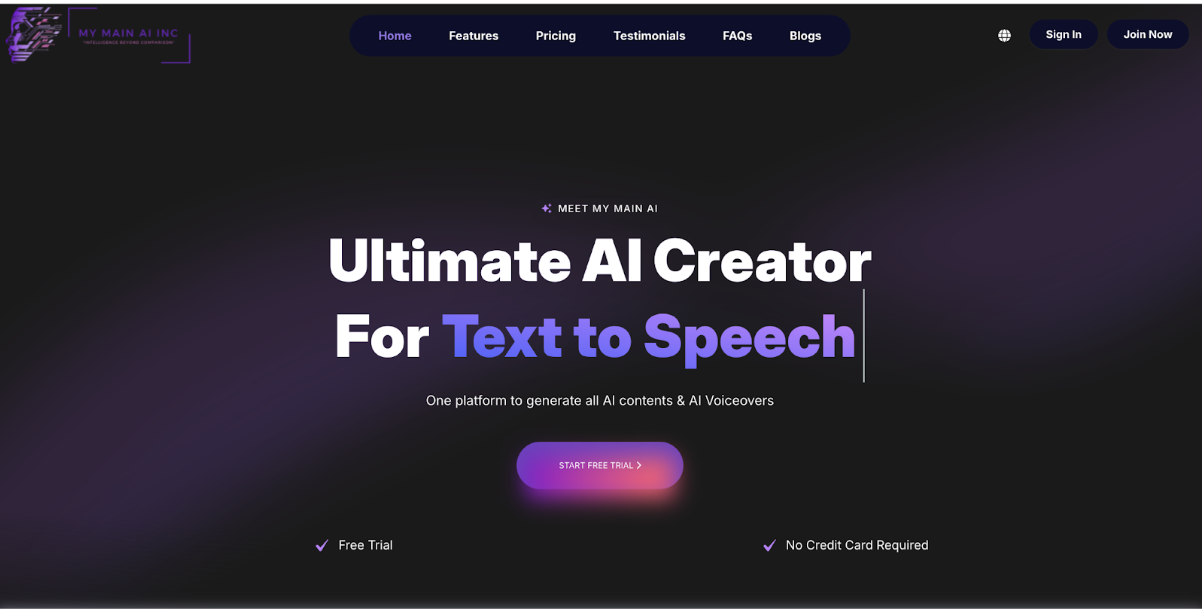
Managing modern workflows often means juggling dashboards, documents, and long email threads before a single task is complete. My Main AI Inc, an AI technology platform that spans text, image, voice, and video, has built a system where many of those steps can be handled through spoken or written prompts instead of manual clicks.
Turning Tasks Into Conversations
My Main AI groups several automation tools around a voice and chat layer so users can move through work by giving instructions rather than configuring each step. The platform lists AI Web Chat, AI Realtime Voice Chat, AI Speech‑to‑Text Pro, and AI Text‑to‑Speech engines from providers such as Lemonfox, Speechify, and IBM Watson, creating a loop between spoken input and generated output.
Speech‑to‑text tools support accurate transcription of audio content in multiple languages, with options to translate those recordings into English. That capability gives businesses a way to record meetings, calls, or field conversations, then convert the results into text that can be summarized, edited, and turned into documents or scripts. Text‑to‑speech tools, including multi‑voice synthesis with up to 20 voices and SSML controls, take written content in the other direction, producing voiceovers for training, marketing, and support material.
Chat assistants extend the same pattern to files and websites. My Main AI lists AI Chat PDF, AI Chat CSV, and AI Web Chat, which allow users to ask questions of documents or site content through natural language prompts. Instead of sorting through long reports, a user can query a file, receive concise answers, and then send follow‑up requests to generate emails, briefs, or summaries in the same environment.
From Content Pipelines to Voice‑Led Workflows
The company reports that its platform connects to more than 100 models from OpenAI, Anthropic, Google Gemini, xAI, Amazon Bedrock and Nova, Perplexity, DeepSeek, Flux, Nano Banana, Google Veo, and Stable Diffusion 3.5 Flash. Public materials state that these models support text, image, voice, and video generation in more than 53 languages, giving the voice‑driven tools reach across several regions and markets.
Content creation sits at the center of many of these workflows. My Main AI offers modules for blog posts, email campaigns, ad copy, social captions, video scripts, and structured frameworks such as AIDA, PAS, BAB, and PPPP. A user can dictate key points or paste a brief into the chat, receive draft text, ask the assistant to adjust tone or length, and then pass the result into voice synthesis to create a narrated version.
Visual tools fit into the same flow. DALL·E 3 HD, Stable Image Ultra, and an AI Photo Studio support image creation, product mock‑ups, background changes, and multiple variations from a single upload. AI Image to Video and text‑to‑video connections with engines such as Sora and Google Veo, alongside an AI Avatar feature labeled “coming soon,” make it possible to turn a spoken or typed brief into images, then into short clips that accompany the newly generated audio.
Why Businesses See Conversation as Infrastructure
Company data shared with partners cites more than 77,000 customers worldwide, annual revenue near 3 million dollars, and monthly revenue growth around 250,000 dollars, driven largely by subscription sales. The 49‑dollar plan is described as the best‑selling tier, with My Main AI presenting it as the entry point to the broader suite of conversational and automation tools.
Business‑oriented features show how these voice‑driven workflows connect to operations. The platform lists payment gateways such as AWDpay and Coinremitter, integrations with Stripe, Xero, HubSpot, and Mailchimp, and tools for SEO, finance analytics, dynamic pricing, wallet systems, and referrals. A manager can ask a chat assistant to pull figures, draft a report, and prepare customer messages, then move directly into sending campaigns or reviewing payments through linked services.
Company communications describe ongoing work on proprietary models, expanded training flows from text, PDFs, and URLs, and deeper tools for chat, analytics, and video. That roadmap suggests that My Main AI views conversation—spoken or typed—as a central control surface for complex workflows, with automation stepping in behind the scenes so users can focus on clear instructions rather than manual configuration.
-

 Tech5 years ago
Effuel Reviews (2021) – Effuel ECO OBD2 Saves Fuel, and Reduce Gas Cost? Effuel Customer Reviews
-
 Tech6 years ago
Bosch Power Tools India Launches ‘Cordless Matlab Bosch’ Campaign to Demonstrate the Power of Cordless
-

 Lifestyle7 years ago
Catholic Cases App brings Church’s Moral Teachings to Androids and iPhones
-

 Lifestyle5 years ago
East Side Hype x Billionaire Boys Club. Hottest New Streetwear Releases in Utah.
-

 Tech7 years ago
Cloud Buyers & Investors to Profit in the Future
-

 Lifestyle5 years ago
The Midas of Cosmetic Dermatology: Dr. Simon Ourian
-

 Health7 years ago
CBDistillery Review: Is it a scam?
-

 Entertainment7 years ago
Avengers Endgame now Available on 123Movies for Download & Streaming for Free