
Business
Exposing a Gap in the Blockchain Economy – Even Security Guards Need Security


Blockchain has made a name for itself by bringing a near fool-proof level of verification to the age of the internet. This is due to the unique way blockchain stores data: Essentially, each new block of data connects to all the blocks before it in a cryptographic chain in such a way that it’s essentially impossible to tamper with. All transactions within the blocks are validated and agreed upon by a consensus mechanism amongst the entire network, ensuring that each transaction is verified and correct.
All of this is true and has stood the test of time thus far. Blockchain has created an impenetrable fortress around the trading of digital currencies and assets, and because of this, trillions of dollars have been traded in this emerging economy. That being said, security is only as valuable as its weakest link. You can fortify your house all you want, when someone has the key to your front door, they’ll walk right in.
In the first six months of 2021 there was a reported 700% increase in SMS phishing compared to the year before. According to a recent Coinbase Security Team article, financial fraud using smishing, a form of phishing that uses mobile phones as the attack platform, is now one of the most used cyber-attacks against cryptocurrency traders. The decentralized nature of blockchain transactions is both its greatest strength and biggest threat in this way. Since there is no governing entity who can reverse a crypto transaction once it has been recorded on chain, malicious actors see this as a prime target for all kinds of phishing attempts to get access to your private key or trading account. With the rapid global adoption of crypto and NFTs we will certainly continue to see an uptick in phone number spoofing and fake 2FA messages.
With this in mind there is a pertinent need for a security solution that will detect and stop phishing threats before they have the chance to succeed. Thankfully Total Network Services (TNS), Rypplzz and Forward Edge-AI have partnered to bring Gabriel® Crypto to the international marketplace. Gabriel Crypto is a revolutionary smartphone security solution that combines Swarm Intelligence, Machine Learning, AI, Natural Language Processing, Tokenized Mobile Equipment Identifiers (E-MEIDs) with patented geospatial intelligence, an Encrypted Blockchain Database, and $DigitalNames into an easy-to-use smartphone defense system.
Originally developed under a National Science Foundation (NSF), Small Business Innovation Research (SBIR) grant, Gabriel was developed to protect consumers against vishing (phishing attacks that involve the use of voice calls) and smishing attacks by Crowdsourcing intelligence, to quickly identify and block dangerous voice calls and text messages. Forward Edge-AI recently partnered with TNS who brings to Gabriel Crypto two of their solutions, $DigitalNames and E-MEID. $DigitalNames provides an alias for public keys to deliver triple factor authentication for every wallet transaction to ensure user information is protected. The E-MEID, powered with patented technology from Rypplzz, records the wireless device’s MEID on a blockchain to create a cryptographically protected immutable record of device software and user licensing.
E-MEID also alerts users of any relevant National Vulnerability Database (NVD) entry. NVD data enables automation of vulnerability management, security measurement, and compliance. Finally, the E-MEID solution provides advanced geolocation data and supply chain management capabilities, via Rypplzz’s Interlife® platform, which can dramatically improve security measures and provide near-real-time operational options based on the location of the associated asset.
Forward Edge-AI was recently approved by an independent third-party risk management and due diligence assessment created by TruSight Solution. TruSight is the best practices third-party assessment service created by leading industry participants for the collective benefit of all financial institutions, their suppliers, partners, and other third parties. Its founders include Wells Fargo, JPMorgan Chase, Bank of America, American Express and BNY Mellon.
Eric Adolphe, Forward Edge-AI’s Chief Executive Officer, stated, “I am pleased to announce that Total Network Services has joined the Gabriel Zero-Day Scam detection ecosystem.” Through its integration with TNS, Gabriel is able to offer an enhanced solution to detect, block, and report smishing attacks in 25 languages. With Purple Alerts™, app users are notified in real-time when it is intelligently detected they are engaging with a scammer by voice or through text messaging. Through the integration with TNS, Gabriel Crypto app users can earn cryptocurrency by participating in a gamified experience that helps to deepen Gabriel security by crowdsourcing intelligence.
Kevin L. Jackson, TNS Senior Vice President sees this as a new and revolutionary cybersecurity step forward. “Gabriel Crypto applies artificial intelligence, machine learning, and crowdsourced intelligence to the protection of cryptocurrency and crypto securities communications and transactions. This cyber-defense advance is a critical need across the new decentralized finance environment.”
Josh Pendrick, Rypplzz’s Chief Executive Officer, commented, “this is a first step towards not only securing the supply chain assets that hold our society together, but to dramatically reduce complexity and improve efficiency in global supply chain resource management.”
About ForwardEdge AI: ForwardEdge AI, Inc.’s mission is to leverage Artificial Intelligence and other emerging technologies to solve complex problems of social consequence. To learn more about ForwardEdge AI visit https://forwardedge-ai.com/
About Total Network Services, Corp:
Total Network Services, Corp (TNS) is a San Diego-based developer of simple, safe and secure blockchain-focused products and services designed to help the world transition into the blockchain economy. TNS’s innovations span across industry boundaries — from FinTech to Telecom security —all supported by its network infrastructure. TNS’s mission is to improve legacy solutions by infusing new levels of verification into the next internet evolution. To learn more about TNS visit https://tnscorp.io/
About Rypplzz, Inc.
Rypplzz has developed a patented spatial computing system, called Interlife, that is transforming the task of secure digital payload delivery and management. Its mission is to optimize efficiency for a sustainable and harmonious society. To learn more about Rypplzz visit https://rypplzz.com/
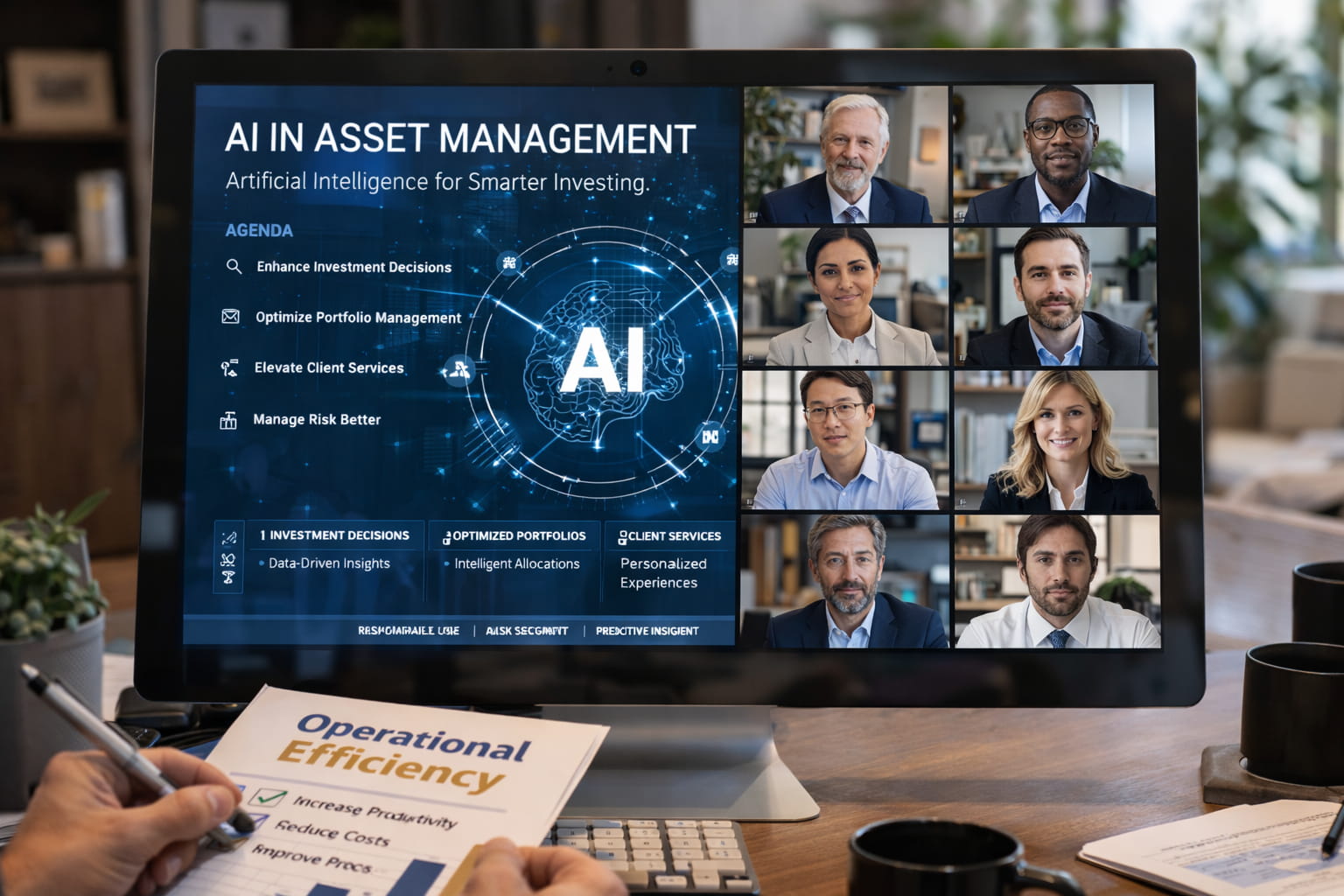
AI in asset management explained at its most basic level is this: using machine learning, data modeling, and automation to make faster and more accurate investment decisions. The applications vary widely across asset classes, fund strategies, and operational functions. Understanding where AI creates real value separates productive adoption from expensive experimentation.
Asset managers now face a data environment far larger than any human team can process manually. Market signals, company filings, macroeconomic indicators, alternative data sources, and portfolio monitoring all generate information continuously. AI tools process that information at scale. They surface patterns that traditional analysis would miss or find too late.
AI in Asset Management Explained Across Core Investment Functions
AI delivers the most measurable results when applied to specific investment functions rather than deployed as a general capability. The clearest applications sit in portfolio construction, risk management, and credit analysis.
Portfolio Construction and Factor Modeling With AI
Traditional portfolio construction relies on return and correlation assumptions built from historical data. AI-driven portfolio tools go further. They process real-time market data, alternative signals, and macroeconomic inputs simultaneously. This surfaces factor exposures that static models miss.
Machine learning models in portfolio construction can:
- Identify non-linear relationships between asset classes that correlation matrices do not capture
- Adjust factor weightings dynamically as market conditions shift rather than on a quarterly rebalancing schedule
- Flag concentration risks before they appear in standard risk reports
- Model tail scenarios using a broader range of historical stress periods than traditional value-at-risk models allow
James Zenni, founder and CEO of ZCG with over 30 years of capital markets experience, has built the platform’s investment approach around the principle that better data and faster analysis produce better outcomes. That view shapes how AI capabilities get deployed across ZCG’s private equity, credit, and direct lending strategies.
Credit Analysis and Private Markets AI Applications
Credit analysis in private markets has historically depended on periodic financial reporting and relationship-based deal intelligence. AI changes that model. Lenders using machine learning tools now monitor borrower health continuously rather than waiting for quarterly covenant tests.
Specific credit applications include:
- Cash flow pattern analysis that identifies revenue deterioration weeks before it shows up in reported financials
- Supplier and customer relationship mapping that flags single-source dependencies and concentration risks
- Covenant monitoring automation that tracks hundreds of credit agreements simultaneously and alerts teams to early warning signs
- Loan pricing models that incorporate current market spread data and comparable transaction history
These capabilities compress the time between identifying a problem and taking action. In credit, that time advantage directly affects loss rates and recovery outcomes.
AI in Asset Management Explained Through Risk and Compliance Applications
Risk management and regulatory compliance represent two of the highest-value AI applications in asset management. Both functions involve processing large volumes of structured and unstructured data under time pressure.
How AI Transforms Risk Monitoring in Asset Management
Traditional risk monitoring produces reports at set intervals. AI-powered risk systems run continuously. They flag anomalies in position data and monitor correlated exposures across a portfolio. Alerts fire when market conditions shift beyond defined thresholds.
The practical risk management applications include:
- Real-time portfolio stress testing against live market inputs rather than end-of-day snapshots
- Liquidity modeling that accounts for position size relative to market depth across multiple scenarios
- Counterparty exposure monitoring that aggregates risk across instruments, custodians, and trading relationships
- Regulatory reporting automation that reduces manual preparation time and lowers the risk of filing errors
ZCG applies these capabilities across its approximately $8 billion in AUM. The platform was founded 20 years ago. It built its investment infrastructure around systematic data analysis and operational discipline.
AI for Operational Efficiency in Asset Management Firms
Beyond investment decisions, AI delivers significant value in fund operations. Back-office functions like reconciliation, reporting, and compliance documentation consume substantial resources at most asset management firms.
AI tools applied to fund operations include document processing systems. These extract and verify data from offering documents, side letters, and subscription agreements automatically. Reconciliation tools flag breaks between custodian records and internal systems automatically. Investor reporting platforms generate customized materials from structured data inputs, reducing the manual production time significantly.
ZCG Consulting (“ZCGC”) advises operating companies across more than a dozen sectors on operational improvement programs, including technology-driven process redesign. Those operational efficiency principles translate directly to asset management back-office functions.
Applying AI to Asset Management: Limitations Firms Must Address
AI in asset management explained fully must include the limitations. Models trained on historical data perform poorly when market regimes change. Overfitting produces tools that work in backtests but fail in live environments. And AI outputs require experienced interpretation to avoid acting on statistically significant but economically meaningless signals.
The ZCG Team approaches AI adoption with the same discipline it applies to investment underwriting. Every tool requires a defined use case and a measurable success metric. A review process keeps experienced judgment in the decision chain. That framework prevents the common failure mode where AI adoption generates activity without improving outcomes.
Firms that treat AI as a capability layer on top of sound investment processes generate sustainable advantages. Those that treat AI as a replacement for process discipline find the technology amplifies existing weaknesses. It rarely corrects them.
-

 Tech5 years ago
Effuel Reviews (2021) – Effuel ECO OBD2 Saves Fuel, and Reduce Gas Cost? Effuel Customer Reviews
-
 Tech7 years ago
Bosch Power Tools India Launches ‘Cordless Matlab Bosch’ Campaign to Demonstrate the Power of Cordless
-

 Lifestyle7 years ago
Catholic Cases App brings Church’s Moral Teachings to Androids and iPhones
-

 Lifestyle5 years ago
East Side Hype x Billionaire Boys Club. Hottest New Streetwear Releases in Utah.
-

 Tech7 years ago
Cloud Buyers & Investors to Profit in the Future
-

 Lifestyle6 years ago
The Midas of Cosmetic Dermatology: Dr. Simon Ourian
-

 Health7 years ago
CBDistillery Review: Is it a scam?
-

 Entertainment7 years ago
Avengers Endgame now Available on 123Movies for Download & Streaming for Free