
Business
Aaron B David from 5 million to 50 million


Trump Towers is the home of the elite and it is home to Aaron B David who is one of the youngest residents of the famous building. He achieved success in alcohol exportation as a result of the legislation that championed certain changes to import law and he also benefited from the abolishment of import duties in China. He heavily invested in buying and letting of properties in the housing market, on the outskirts of London, and took advantage of the rising London prices for houses. Aaron B David formulated a business design around providing affordable housing in the areas close to London.
His competitive advantage was a consequence of his willingness to buy less patronized locations or less valued areas. This was when everyone was buying houses in London, England. After he predicted the hike in housing prices in London and the prospect that there will be a mass movement of people out of the city. This venture yielded massive profits as the rapidly increasing property prices catapulted him into the millionaire’s circle.
A millionaire at such a young age in the rapidly growing buy-to-let housing business space, he has earned plaudits because he understands what the customer wants. He is still quite young and already a success with more room left for more achievements. All eyes are on him to see what greater achievements still await this genius.
Aaron B David has good taste in art and is quite knowledgeable. He possessing a drool-worthy stock of some of the greatest art pieces and built a million-pound art collection with some expensive pieces from artists such as Andy Warhol and Jeff Koons, to mention a few. Although Aaron B David has a flair for art, he also invests in art through many people In the art world will frown upon such an act but to him, it is part of the business.
Andy Warhol (1928-1987)
The Dollar Sign, Green
In the Dollar Signs, Andy was quoted stating that “big-time art yields big-time money” and, with this principle, he published the dollar sign representing money as the sign for art. Considering the feral color and striking drawing and design, the Dollar Signs are of artistic essence.
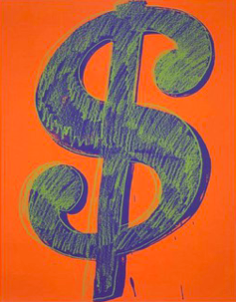
Andy Warhol was an accomplished magazine and ad artist who became renowned as one of the best artists of the 1960s Pop art evolution. He practiced diverse forms of art such as performing arts, filmmaking, video installations, and writing. He caused controversy by breaking the bonds between fine art and mainstream aesthetics.
In 2018, Aaron B David invested in a watch trading group that collects watches and sold to carr watches, whose clients include boxer Anthony Joshua OBE, Carl Froch, and international boxing supporter Eddie Hearn and other celebrities.
Aaron’s investment philosophy focuses on tangible assets. He invests solely in property, art and he collects watches.
What is the cost of a Jeff Koons’ art piece?
November 12, 2013, Jeff Koons’ popular Balloon Dog was purchased for an exorbitant price of about US$58.4 million, which was higher than its $55 million estimates. It is currently the most expensive artwork made by a living artist sold at auction.

Real Estate statistics in Atlanta
In 2019, Aaron B David invested heavily in properties in Atlanta. His big picture is to build modern affordable houses and this was the perfect time to achieve this goal.
Atlanta has a mixture of owner-occupied housing units as well as renter-occupied units. Last month, 1203 homes were sold in Atlanta, Georgia on Redfin.com, a popular national real estate brokerage website. Also, there were about 1572 condos, 892 townhouses, and 79 multi-family house units put up for sale in Atlanta last month. The average listing price is around $299,000. The average sale price of a house in Atlanta was about $300K last month, an upgrade of up to 11.1% since last year. The average sale price per square foot in Atlanta is up to $196, up 7.1% since last year.
According to reports, the Atlanta housing market is relatively competitive. The housing units sell for about 3% lesser than the list price and can go pending for 59 days. A compelling price listing in the market can sell for the listing price and go pending for about 20 days. He’s got the eye for long term business prospects that will yield millions of profit in a matter of years.
Every quarter brings fresh headlines in fintech, but few make the kind of impact achieved by Black Banx in Q2 2025. The Toronto-based global digital banking group, founded by Michael Gastauer, reported an extraordinary USD 4.3 billion in revenue and a record USD 1.6 billion in pre-tax profit, while improving its cost-to-income ratio to 63%.
These results not only highlight the company’s operational efficiency but also mark a pivotal moment in its journey from challenger to global leader. The big question is: what’s fueling such impressive financial performance?
Customer Growth as the Core Driver
One of the clearest engines of revenue growth is Black Banx’s expanding customer base. By Q2 2025, the platform had reached 84 million clients worldwide, up from 69 million at the end of 2024. This 15 million net gain in six months demonstrates both the attractiveness of its services and the scalability of its model.
Unlike traditional banks, which rely heavily on branch expansion, Black Banx leverages digital-first onboarding that allows customers to open accounts within minutes using just a smartphone. This approach is especially effective in regions underserved by legacy institutions, where access to affordable financial tools is in high demand.
More customers don’t just mean higher transaction volumes—they generate a compounding effect where network size, brand trust, and service adoption reinforce one another.
Real-Time Payments and Cross-Border Solutions
A major contributor to Q2 revenues is the platform’s real-time payments infrastructure. Black Banx enables instant cross-border transfers across its 28 supported fiat currencies and multiple cryptocurrencies, helping both individuals and businesses bypass the traditional bottlenecks of international banking.
For freelancers, SMEs, and multinational clients, this means faster liquidity, reduced foreign exchange costs, and simplified global operations. The demand for real-time financial services is growing rapidly—Juniper Research projects global real-time payments turnover to hit USD 58 trillion by 2028—and Black Banx is strategically positioned to capture a significant share of this market.
Crypto Integration as a Revenue Stream
Another key revenue driver is crypto integration. While many traditional institutions remain hesitant, Black Banx embraced digital assets early and has built infrastructure to support Bitcoin, Ethereum, and the Lightning Network. In Q2 2025, 20% of all transactions on the platform were crypto-based, reflecting strong customer appetite for hybrid banking services that bridge fiat and digital assets.
Revenue comes not only from transaction fees but also from value-added services like crypto-to-fiat conversion, staking yields (4–12% APY), and blockchain-enabled payments. For customers in markets with unstable currencies, these services act as a financial lifeline, further expanding the platform’s relevance.
AI-Powered Efficiency and Risk Management
Record revenues would be less impressive if costs ballooned at the same rate. But Black Banx has proven adept at balancing growth with efficiency. Its cost-to-income ratio improved to 63% in Q2, down from 69% a year earlier, thanks to heavy reliance on AI-powered automation.
AI now drives fraud detection, compliance, and customer onboarding—areas where traditional banks often struggle with cost inefficiencies. By automating these processes, Black Banx can process millions of transactions securely while maintaining profitability at scale. This level of efficiency is rare in fintech, where high growth often comes at the expense of margins.
Regional Expansion and Untapped Markets
Geography also plays a role in fueling revenues. Much of the Q2 growth came from Africa, South Asia, and Latin America—regions where demand for mobile-first banking continues to soar. In 2024 alone, Black Banx reported a 32% increase in SME clients from the Middle East and Africa, signaling the strength of its positioning in underserved markets.
By extending services to populations previously excluded from formal banking—migrant workers, rural communities, and small businesses—Black Banx taps into vast pools of latent demand. The strategy proves that financial inclusion and profitability are not mutually exclusive but mutually reinforcing.
Diversified Revenue Streams
Another factor behind Q2’s record revenues is Black Banx’s diversified business model. Income is not tied to a single service but spread across multiple streams, including:
- Transaction fees from cross-border transfers and payments.
- Crypto trading and exchange services.
- Premium account features for high-net-worth clients.
- Corporate services for SMEs and international businesses.
This diversification insulates the company against volatility in any single segment, creating stable revenue growth even in shifting market conditions.
Michael Gastauer’s Strategic Blueprint
Behind these results is Michael Gastauer’s long-term strategy: scale aggressively but with efficiency, innovation, and inclusion at the core. His vision has always been to create a borderless financial ecosystem, and Q2 2025’s performance is evidence that this vision is not only achievable but sustainable.
By balancing mass-market accessibility with premium features, and by blending fiat with digital assets, Gastauer has positioned Black Banx as a category-defining player in global finance.
The Road Ahead: Toward 100 Million Clients
Looking forward, the company’s goal of reaching 100 million customers by the end of 2025 will likely be the next catalyst for revenue growth. More customers mean more transactions, more data insights, and more opportunities to refine and expand its service offering.
If current momentum holds, the USD 4.3 billion quarterly revenue milestone could be just the beginning of an even larger growth story. The challenge will be ensuring systems scale securely while maintaining trust in an environment where privacy and compliance are paramount.
A Record That Signals More to Come
Black Banx’s Q2 2025 performance—USD 4.3 billion in revenue, USD 1.6 billion in pre-tax profit, 84 million clients worldwide, and a lean 63% cost-to-income ratio—is more than a financial milestone. It is a signal of how the future of banking is being rewritten by platforms that are borderless, crypto-inclusive, and data-driven.
What fueled this record-breaking quarter is not one innovation but a combination of strategies—scalable onboarding, real-time payments, crypto integration, AI efficiency, and expansion into underserved regions. Together, they form a model that doesn’t just challenge traditional banking but actively builds the foundation for global dominance.
For Black Banx, the road ahead is clear: the $4.3 billion quarter is not an endpoint but a launchpad for even greater scale and profitability.
-

 Tech5 years ago
Effuel Reviews (2021) – Effuel ECO OBD2 Saves Fuel, and Reduce Gas Cost? Effuel Customer Reviews
-
 Tech7 years ago
Bosch Power Tools India Launches ‘Cordless Matlab Bosch’ Campaign to Demonstrate the Power of Cordless
-

 Lifestyle7 years ago
Catholic Cases App brings Church’s Moral Teachings to Androids and iPhones
-

 Lifestyle5 years ago
East Side Hype x Billionaire Boys Club. Hottest New Streetwear Releases in Utah.
-

 Tech7 years ago
Cloud Buyers & Investors to Profit in the Future
-

 Lifestyle6 years ago
The Midas of Cosmetic Dermatology: Dr. Simon Ourian
-

 Health7 years ago
CBDistillery Review: Is it a scam?
-

 Entertainment7 years ago
Avengers Endgame now Available on 123Movies for Download & Streaming for Free