
Business
The Guide to Manufacturing in Monterrey


In the present time, Monterrey has become a booming manufacturing industrial location and anyone can start their own operation choosing the simple way- seeking help of a shelter service provider.
Some facts to know about manufacturing in Monterrey
Monterrey is the capital of Nuevo Leon and third biggest city in Mexico. It is a developing metropolis with a city population of more than one million and an area population of more than 4.5 million. Monterrey is a commercial and industrial hub and major hotspot for transportation in northern Mexico. It abodes every leading industry and has a gigantic labor market flooded with skilled employees. Brands like IKEA, Whirlpool, BMW, Kia have made Monterrey their manufacturing abode.
What makes Monterrey a good location for industries?
- Strategic location: Monterrey is sited just below Texas, and a small 2-hour road drive links it to several border crossings. The industrial park Monterrey spread across five industrial regions. The Monterrey International Airport has gained a lot of popularity in Mexico.
- Developing workforce: The technical schools of Monterrey are famous for engineering and IT skilled people. The UANL network of educational institutes is the third- biggest in Mexico and has over 26 colleges, 24 high schools, 3 technology schools, 26 colleges and a bilingual education hub.
- Industries: Monterrey is home to aerospace, automotive, medical, and plastic and HVAC industries. Major brands such as IKEA, KIA, Jon Deere, and Whirlpool have set up their operating units here. Monterrey has over 30% of electronics manufacturing.
- Standard of living: Monterrey is known among foreign nationals and is one of the most Americanized places of Mexico. It has the greatest per capita income in the nation and offers a lot of convenience.
How does Shelter Services make manufacturing simpler in Monterrey?
The shelter model of manufacturing in Monterrey lets foreign companies to work in collaboration with a local provider to set up manufacturing facility here. In Monterrey, a lot of companies choose to work by integrating with a shelter service provider to lower the risks of developing operations all by themselves. Monterrey offers a lot of advantage when you work with a provider like experienced setup and maintenance of an offshore manufacturing operation.
- Shelter services in Monterrey make it simple for a lot of businesses to use all the different modes of entry for setting up a manufacturing unit in Mexico.
- Acquiring security from possible pitfalls exposure when establishing an operation facility alone, especially when working with new labor force, tax rules and trade laws.
- Lessening the administrative load of operations, the shelter service providers in Monterrey work as the legitimate entity acting on behalf of the company, allowing you to focus more on production.
So, when setting up a facility in industrial park Monterrey, seek help of a professional shelter company to avoid all the hurdles and get your business running. It helps to lower your learning curve linked with setting up a manufacturing unit alone. Avail the services as per your requirement and avail all the benefits of working in Monterrey.
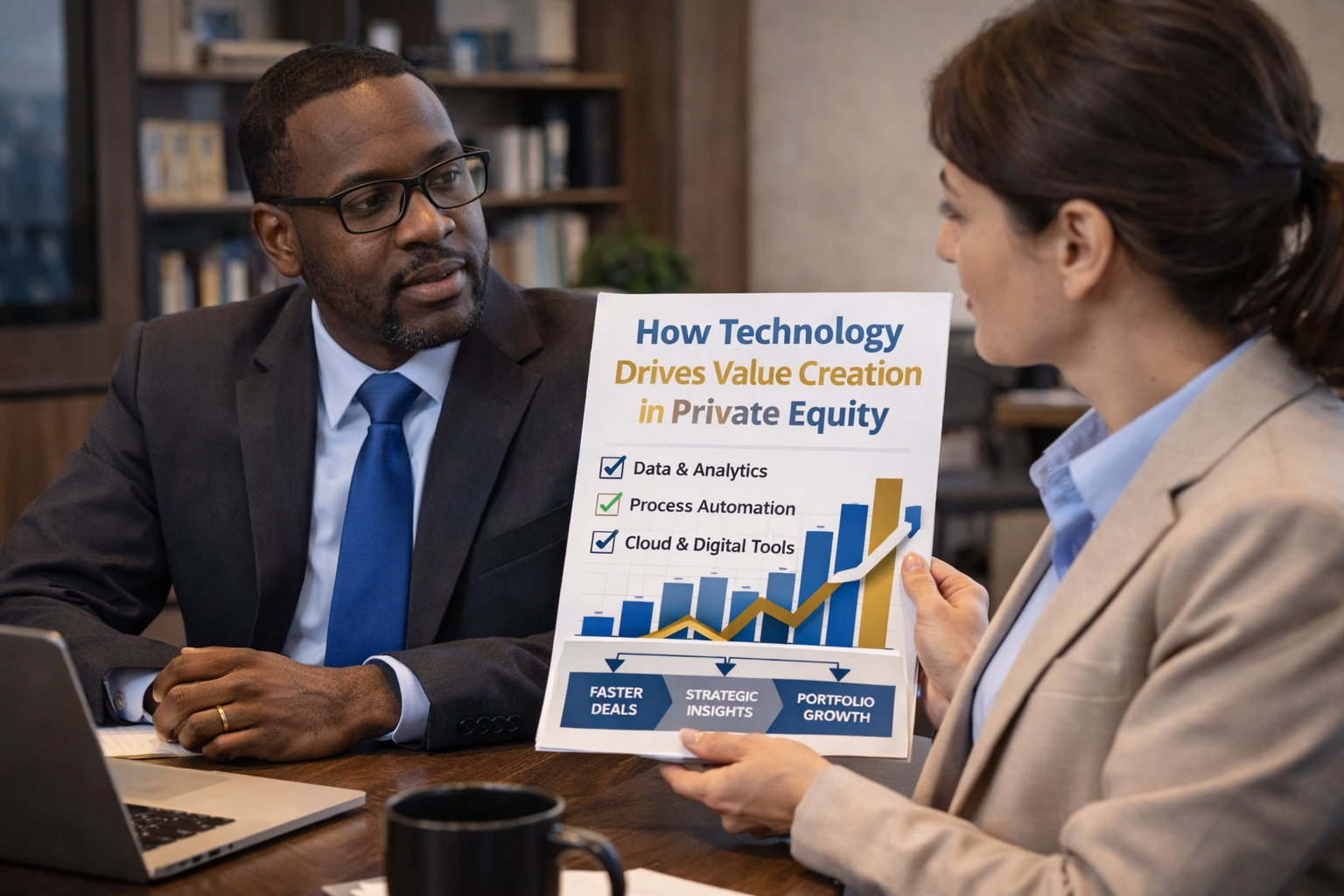
How technology drives value creation in private equity is now one of the most actively debated topics among institutional investors and fund managers. A decade ago, technology was largely a cost center in PE-backed companies. Today it sits at the center of margin improvement, revenue growth, and exit multiple expansion. Firms that figured this out early are generating better returns with less reliance on financial engineering.
The shift happened for a practical reason. As interest rates rose and deal multiples compressed, financial leverage stopped doing the heavy lifting. Operational improvement became the primary value creation lever. Technology accelerated what was possible within the ownership period.
How Technology Drives Value Creation in Private Equity Operations
Operational improvement through technology produces the most measurable results. PE firms apply technology tools to reduce costs, increase throughput, and improve decision-making speed inside their companies.
Digital Process Automation in PE-Backed Companies
Manual processes in back-office and production functions carry real costs. They consume labor, generate errors, and slow down the information flow that management teams depend on. Automation tools eliminate these costs without requiring headcount reductions that disrupt company culture.
The most impactful automation deployments in PE-backed operations include:
- Accounts payable and receivable automation that compresses billing cycles and reduces days sales outstanding
- Production scheduling software that reduces downtime and improves throughput in manufacturing environments
- Inventory management systems that cut carrying costs by aligning purchasing with real-time demand signals
- Quality control automation that reduces defect rates and warranty claims in product-based businesses
ZCG Consulting (“ZCGC”) works with companies across industrials, manufacturing, packaging, and consumer products to identify and implement automation programs tied to specific financial outcomes. The approach connects technology investment to measurable margin improvement rather than treating automation as a general upgrade.
Data Infrastructure as a Value Creation Tool
Many PE-backed companies arrive under new ownership with fragmented data systems. Different departments use different tools. Reporting requires manual consolidation. Leadership makes decisions with incomplete information.
Fixing that infrastructure creates immediate value. Integrated data systems give management teams real-time visibility into revenue, cost, and operational performance. That visibility accelerates decisions and surfaces problems before they become material.
James Zenni, founder and CEO of ZCG with over 30 years of capital markets experience, has consistently emphasized that information quality drives investment performance. That view shapes how ZCG approaches technology investment across the companies in its portfolio.
Technology Drives Value Creation in Private Equity Through Revenue Growth
Cost reduction gets most of the attention in PE operational improvement, but technology also drives revenue growth. The mechanisms are different, and they compound differently over a hold period.
E-Commerce and Digital Customer Acquisition
Companies that sell primarily through traditional channels often leave significant revenue on the table. Adding e-commerce capabilities or investing in digital customer acquisition expands the addressable market without proportional cost increases.
PE firms that invest in digital revenue channels generate higher growth rates during the hold period. That growth rate difference translates directly into exit multiple expansion.
Revenue growth technology applications in PE-backed companies include:
- E-commerce platform buildouts that open direct-to-consumer channels alongside existing wholesale relationships
- Customer relationship management systems that improve retention and increase repeat purchase rates
- Digital marketing infrastructure that lowers customer acquisition costs through better targeting and attribution
- Pricing optimization tools that identify margin improvement opportunities without volume loss
Technology-Enabled Customer Experience Improvements
Customer retention is cheaper than customer acquisition. Technology investments in customer experience, service speed, and product quality consistency reduce churn. Lower churn produces more predictable revenue. More predictable revenue supports higher exit valuations.
ZCG deploys Haptiq Technologies and Solutions, its 300-plus-person technology division, to support digital transformation across its companies. The platform was founded 20 years ago and manages approximately $8 billion in AUM. It brings implementation resources that most individual companies cannot afford to build internally. That capability gives ZCG’s companies faster access to technology improvements at lower execution risk.
Building Technology Capability Within PE-Backed Companies
Technology investment during the hold period creates value in two ways. It improves financial performance during ownership. It also makes the business more attractive to the next buyer.
Strategic buyers and later-stage PE funds pay premium multiples for companies with modern technology infrastructure. A business with integrated systems, clean data, and digital revenue channels commands a better price. A comparable business running on legacy platforms does not.
The ZCG Team structures technology investment as part of the initial value creation plan for each company. Priorities get set at entry based on the gap between current capability and acquirer expectations.
This pre-sale positioning approach changes how technology investment gets funded and sequenced during the hold period. Projects that improve financial performance and exit readiness simultaneously get prioritized. Projects with long payback periods that do not improve the sale narrative get deferred.
How technology drives value creation in private equity is ultimately about execution discipline. The tools matter less than the clarity of the financial objective each technology investment must achieve.
-

 Tech5 years ago
Effuel Reviews (2021) – Effuel ECO OBD2 Saves Fuel, and Reduce Gas Cost? Effuel Customer Reviews
-
 Tech7 years ago
Bosch Power Tools India Launches ‘Cordless Matlab Bosch’ Campaign to Demonstrate the Power of Cordless
-

 Lifestyle7 years ago
Catholic Cases App brings Church’s Moral Teachings to Androids and iPhones
-

 Lifestyle5 years ago
East Side Hype x Billionaire Boys Club. Hottest New Streetwear Releases in Utah.
-

 Tech7 years ago
Cloud Buyers & Investors to Profit in the Future
-

 Lifestyle6 years ago
The Midas of Cosmetic Dermatology: Dr. Simon Ourian
-

 Health7 years ago
CBDistillery Review: Is it a scam?
-

 Entertainment7 years ago
Avengers Endgame now Available on 123Movies for Download & Streaming for Free